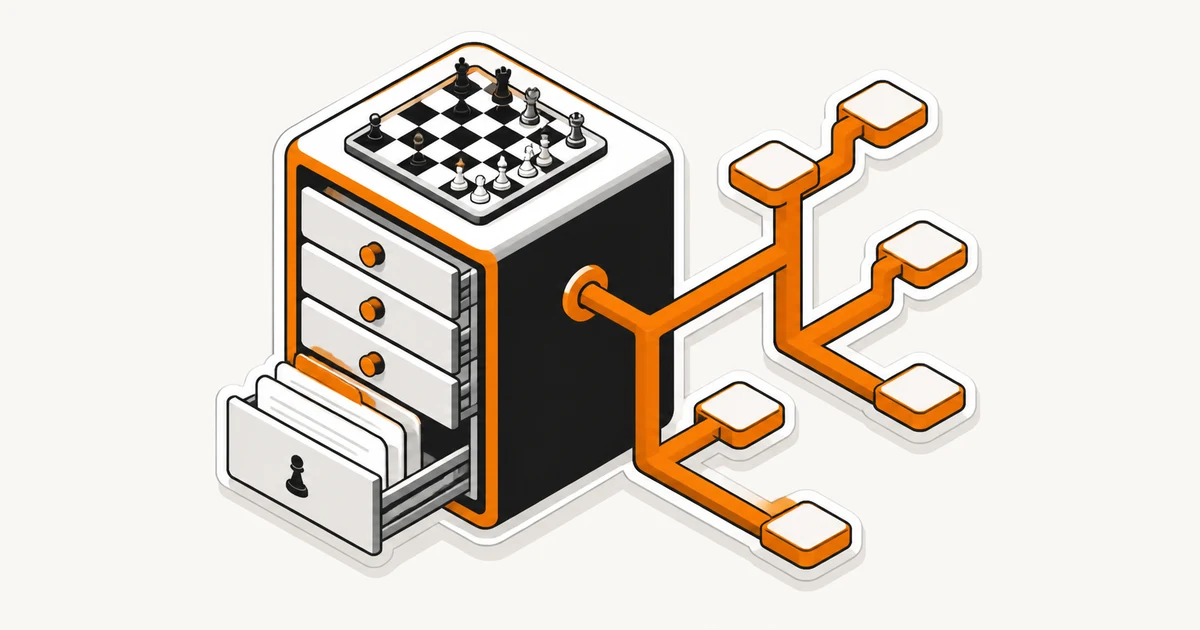
Chess Opening Repertoire Builder: learn and train this chess opening
Build a compact repertoire, train it with recall, and keep it alive with real-game feedback.
Start with the move order, then use the plans, variations, traps, and training workflow below to turn Chess Opening Repertoire Builder into a repertoire you can review with active recall and spaced repetition in ChessFlare.
A chess opening repertoire is not a folder of every line you once liked. It is a practical set of choices for White and Black that you can remember, review, and trust in real games.
A good chess opening repertoire builder should therefore do more than store moves. It should help you choose lines, structure them in a readable tree, train them with active recall, schedule review, and update weak branches after your games.
The best repertoire builder is not the one with the most theory. It is the one that keeps your opening choices playable after the first study session.
For most players, that means three things:
one clear White repertoire
one reliable answer to 1.e4 and 1.d4 as Black
a review loop that brings back the lines you forget or lose with
If your tool stops at saving PGNs, you still have to build the training system yourself.
What the SERP gets right
Most winning pages around this topic answer the same user problem: players do not only ask which opening is best. They ask how to build a repertoire without drowning in theory.
That is why strong content mentions style, common replies, move trees, spaced repetition, and real practice. Those are the real buying criteria. A player wants fewer guesses on move one, not another database they never open.
What a repertoire builder must solve
A serious chess opening repertoire builder should answer these questions:
What do I play as White?
What do I play against 1.e4, 1.d4, 1.c4, and 1.Nf3?
Which sidelines appear often at my level?
Which branches are only notes, and which are trainable repertoire?
What should I review today?
Which opening mistakes keep showing up in my games?
If those answers live across a PGN file, a video, a spreadsheet, and a separate trainer, the repertoire will decay.
Build from player reality, not theory anxiety
Many players start with a grandmaster course, copy 20 moves, then feel behind because they cannot remember the line. That is backwards.
Start from your games, your style, and your available review time. A club player needs a compact repertoire that reaches understandable middlegames. Rare sidelines matter less than the replies you actually face every week.
Opening explorer data can help, but raw percentages are not a plan. They show what people play; you still need to decide what belongs in your own system.
Build a repertoire that survives real games
Centralize PGN, chapters, branches, comments, and plans
Turn opening lines into active recall and spaced review
Choose openings that fit your style and maintenance budget. If you like open tactical games, do not force yourself into slow structures. If you have limited study time, avoid lines that require constant memorization just to survive.
2. Structure the tree
Long PGNs become unreadable fast. Use chapters, branches, comments, and plans. A move tree matters because most opening problems happen at splits: sidelines, transpositions, and move-order details.
ChessFlare helps here because PGN structure and training are connected. The same material can become a recall drill instead of staying as static notes.
3. Train recall
Reading a line is recognition. Training starts when the answer is hidden and you must find the move.
A good repertoire builder turns every important branch into a board question: what do you play here, what is the plan, and what if the opponent chooses a common sideline?
4. Schedule review
You should not guess what to review today. Hard or forgotten moves should return sooner. Stable lines should come back later.
That is the point of spaced review: keep the repertoire alive without rereading everything every week.
5. Feed real games back into the tree
A repertoire is never finished. If you lose twice in the same sideline, that branch needs attention. If a line never appears, it probably should not dominate review time.
With ChessFlare, real-game review can send you back to the opening branch, not just to a one-time engine report.
A 30-minute setup
Use the first 10 minutes to choose one line you already play. Use the next 10 minutes to remove unnecessary depth and add plan notes. Use the final 10 minutes to train the line without seeing the answer.
The next day, review only what you missed.
That small loop beats a giant import you never maintain.
When ChessFlare fits best
Use ChessFlare if your opening work is scattered across PGNs, studies, notes, videos, and real-game mistakes.
The strongest fit is not “I need one more place to save lines.” It is “I need one workflow where my repertoire can be built, trained, reviewed, and corrected.”
The best chess opening repertoire builder keeps your lines playable. It connects selection, PGN structure, active recall, spaced review, and feedback from real games.
That is where ChessFlare is strongest: it turns a repertoire from stored theory into a training loop you can keep using.