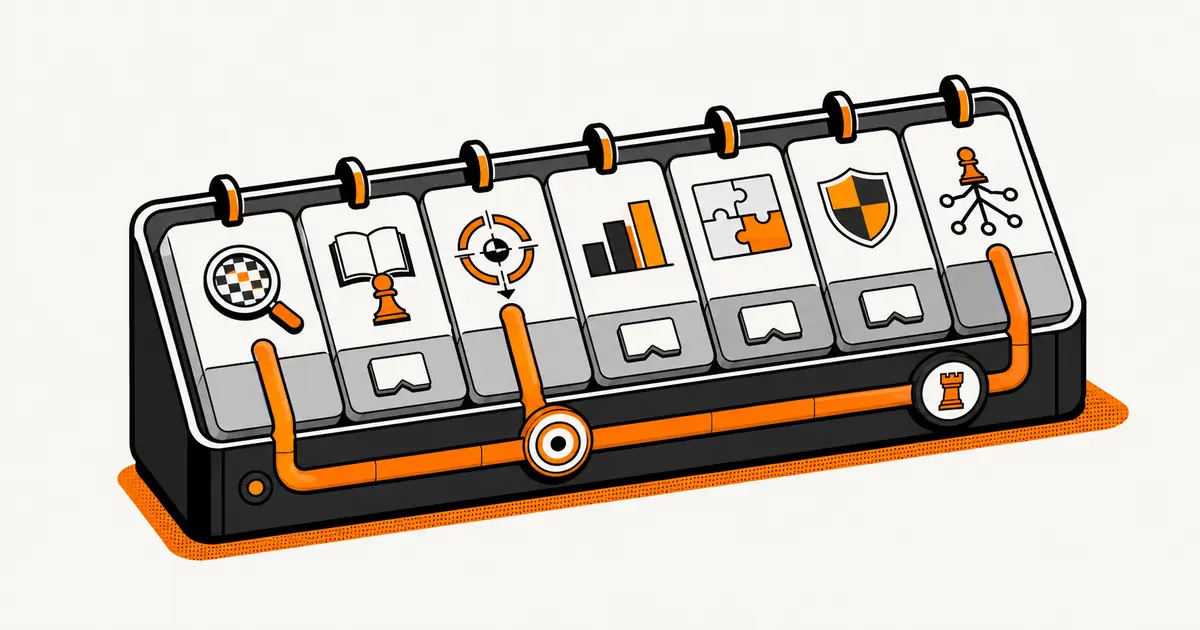
A practical weekly routine for players who want real progress from games, review, openings, tactics, and weak spot training.
A useful chess study plan is not a long wish list. It gives each week a repeatable loop: play a serious game, review the mistake, train the weak spot, and keep openings alive.
A good chess study plan is not a huge checklist. It is a repeatable loop: play a serious game, review what changed the result, train the repeated weakness, keep one opening branch alive, and test the fix in your next games.
If you only solve random puzzles or watch random videos, you can feel busy without changing your results. A stronger routine connects study to your own games. ChessFlare is useful for that because you can play online, review real games with Game Summary, inspect key positions with analysis, send decisive mistakes into Blunder Review, track patterns with Advanced Player Stats, and keep opening lines fresh with spaced review.
Quick answer: what should a chess study plan include?
A practical chess study plan should include four blocks every week: serious games, game review, targeted tactics, and opening maintenance. Endgames and calculation can rotate in, but the core loop should always start from your own games.
For most club and online players, the best study week is not ten different topics. It is two or three serious games, one honest review session, three short tactical sessions based on repeated mistakes, and one opening review session focused on lines you actually reach.
The weekly routine that works for most players
Use this as a default routine if you do not know where to start:
Play two serious games
Review both games before playing more
Pick one repeated mistake pattern
Train that pattern in short sessions
Review one opening branch you reached
End the week with one test game
This works because it prevents study from drifting. Your games create the training agenda. Your review decides the next pattern. Your opening work stays close to positions you actually face.
How much time should you spend?
If you have three hours per week, split it like this:
Training block
Time
Goal
Serious games
60 minutes
Create real positions to learn from
Game review
45 minutes
Find the mistakes that changed results
Targeted tactics
45 minutes
Fix the pattern that keeps recurring
Opening review
30 minutes
Keep one playable branch ready
If you have more time, do not just add more puzzles. Add better review. Most players already know enough chess material to improve; they do not extract enough from their own games.
Why random training fails
Random training feels productive because every session gives you something new. The problem is that your rating does not care how much material you touched. It cares whether you stop repeating the same mistakes in games.
A player who loses pieces to pins does not need a broad puzzle diet first. They need to recognize pins before the piece falls. A player who exits the opening with a bad structure does not need five new openings. They need to understand the branch that keeps appearing in their games.
That is why ChessFlare's strongest workflow is the full loop: real game, summary, analysis, blunder review, stats, weak spot training, then opening or study review. The point is not to collect more data. The point is to turn the next session into a specific correction.
Below 1000 Elo, prioritize blunder checks, hanging pieces, basic tactics, and simple endgames. Keep openings small and playable.
From 1000 to 1400, add structured review. You should know which mistakes repeat: missed threats, weak king safety, rushed captures, opening exits, or poor conversion.
From 1400 to 1800, your plan needs more calculation, cleaner opening branches, and deeper game review. You still need tactics, but the tactical work should come from positions that match your games.
Above 1800, study becomes more personal. Opening depth, calculation discipline, endgame technique, and opponent preparation matter more. But the loop stays the same: evidence from games first, training second.
How to connect openings to the study plan
Opening study should not be a separate hobby. Keep it tied to games you actually play. When an opening branch appears in a game, review that branch, add a note, and train the critical moves with active recall.
In ChessFlare, this is where a repertoire workflow helps. You can build or import PGN lines, organize branches, train them with the Opening Trainer, and use spaced review so fragile lines come back sooner. That is more durable than rereading a PGN once and hoping it survives a blitz game.
How to review games without wasting time
Do not review every move equally. Start with three questions:
Where did the evaluation or practical result change?
Was the mistake tactical, strategic, opening-related, endgame-related, or time-pressure-related?
What small training task would make this less likely next week?
This keeps analysis useful. Engine output can show the best move, but your study plan needs the reason you missed it. If the miss was a loose piece, train loose pieces. If it was a repeated opening exit, train that branch. If it was time trouble, change your move rhythm.
A simple seven-day chess study plan
Monday: one serious game and quick notes.
Tuesday: review that game and tag one mistake pattern.
Wednesday: short targeted tactics session.
Thursday: opening branch review from the game.
Friday: second serious game.
Saturday: deeper review with analysis and blunder review.
Sunday: light spaced review and one short test session.
The exact days do not matter. The order matters: play, review, train, repeat.
When should you change your plan?
Change the plan only when the evidence changes. If three losses in a row come from time trouble, your next week should include slower games and move rhythm. If your losses come from one opening structure, do not jump to a new opening; fix the structure first.
The best study plan is boring in the right way. It repeats the few things that move your games, not the many things that look interesting.
Build the plan from evidence
A chess study plan should start with proof, not ambition. Before adding hours, look at the last ten serious games and write down the losses in plain language: missed tactic, bad opening plan, time trouble, weak king, traded into lost ending, or failed conversion. Patterns matter more than mood. One ugly loss can feel huge, but a repeated leak is where training time belongs.
This prevents the common mistake: copying a grandmaster-style schedule with openings, endgames, strategy, calculation, books, videos, and engine work every week. That plan looks impressive and dies quickly. A useful plan is smaller and harder to escape. It names the next few weaknesses and gives each one a repeatable slot.
A 30, 60, and 90 minute version
If you have 30 minutes, use a narrow loop: ten minutes of tactics, ten minutes reviewing one recent mistake, ten minutes repeating one opening or endgame position. Do not add video unless it replaces one of those jobs.
If you have 60 minutes, play or review one serious game segment, then train the theme that appeared. For example: calculation mistake, defensive tactic, isolated pawn plan, rook ending, or forgotten opening branch.
If you have 90 minutes, add one deeper block. Analyze first without engine, write what you thought during the game, then check with engine and save only the useful correction. The goal is not to collect beautiful lines. The goal is to create tomorrow's drill.
What changes by rating
Under 1000, the plan should be brutally practical: hang fewer pieces, see one-move threats, learn basic mates, and stop playing openings that lose material immediately. Short tactical repetition beats deep theory.
From 1000 to 1600, the plan should connect tactics with review. You need to know which motifs repeat and which opening structures produce them. Add basic endings and one simple repertoire, but keep most time on calculation and game review.
Above 1600, the plan becomes more diagnostic. You can ask whether the recurring issue is calculation, decision-making, structure, time use, opening preparation, or conversion. Study becomes less about more content and more about sharper feedback.
Tournament week vs normal week
A normal week can build broad skills. Tournament week should reduce noise. Review your main openings, repeat known tactical weak spots, check common endgames, and sleep before adding new theory. New material feels productive but often steals confidence.
The day after a tournament, do the opposite: collect evidence. Which losses were preparation problems? Which were tactical misses? Which were emotional or clock problems? That review becomes the next study plan.
Start with one training loop
If you want a plan that is easy to keep, start with one ChessFlare loop this week: play a serious game, open the summary, review the decisive mistake, train the weak spot, and review the opening branch that appeared.
That is enough to turn study from scattered effort into a system. Once the loop is working, add more volume.
Short answers for players building a weekly chess training routine.
What is the best chess study plan?
The best chess study plan starts from your own games: play serious games, review decisive moments, train the repeated weakness, and keep opening branches fresh.
How many hours per week should I study chess?
Three focused hours per week can work if they include serious games, review, targeted tactics, and opening maintenance. More time helps only if review quality stays high.
Should I study tactics or openings first?
Study tactics first if you hang pieces or miss threats. Study openings only enough to reach playable positions, then deepen the branches you actually get in games.
How do I review my chess games?
Find the moments that changed the result, classify the mistake, then turn it into one training task. Do not spend equal time on every move.
Can ChessFlare help with a chess study plan?
Yes. ChessFlare connects online play, game summary, analysis, blunder review, stats, weak spot training, repertoire work, and spaced review in one loop.
How long should I follow a chess study plan?
Follow one plan for at least four to eight weeks unless your games show a clear new weakness. Change the plan from evidence, not boredom.