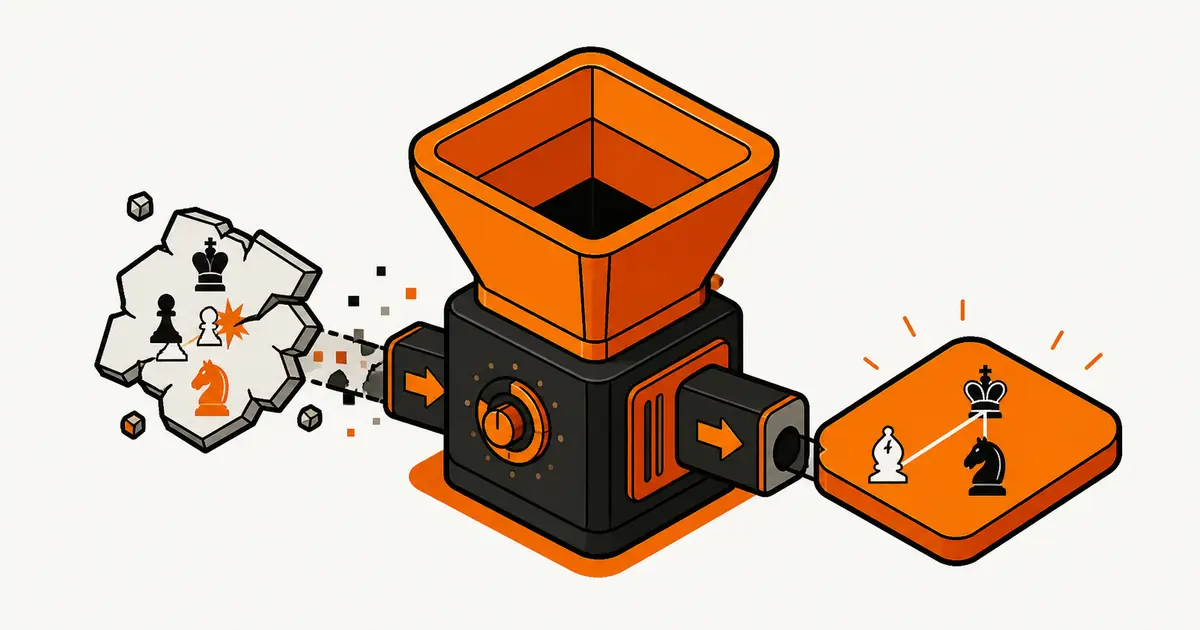
The best tactics trainer is not the one with the biggest puzzle count. It is the one that helps you stop missing the same patterns in real games.
A chess tactics trainer should help you spot patterns in real games, not just collect a higher puzzle rating. Train motifs, mixed calculation, and the mistakes your own games reveal.
A good chess tactics trainer should do more than give you endless puzzles. It should build pattern recognition, reveal which motifs you miss in your own games, and help you repeat those weak spots until they become visible during play.
If you only want a quick puzzle streak, many tools work. If you want tactics to change your results, the better workflow is: review real games, identify the repeated tactical leak, train that motif, then keep mixed puzzles in the routine so calculation stays honest. ChessFlare connects that loop with Game Summary, Blunder Review, analysis, Advanced Player Stats, and Weak Spot Puzzle.
Quick answer: what makes a chess tactics trainer good?
A good tactics trainer combines three jobs: motif repetition, realistic calculation, and personal targeting. Random puzzles help pattern recognition, but targeted puzzles from your actual mistakes help you stop repeating the patterns that cost games.
Use a pure puzzle site if you want a large puzzle library and a rating. Use ChessFlare if you want tactics training tied to your own games: the blunders you miss, the motifs that repeat, and the next drill that fits your review history.
The mistake most players make with tactics training
Most players treat tactics like volume work. They solve more puzzles, protect a streak, and feel productive. The problem is that real games do not announce "there is a tactic here." You must notice the trigger: loose piece, exposed king, overloaded defender, trapped piece, back-rank weakness, or forcing move sequence.
That is why a tactics trainer should not only ask whether you found the move. It should help you understand what made the tactic possible and whether you miss the same cue in your own games.
What to look for in a chess tactics trainer
Use this checklist before choosing a tool:
It trains motifs, not only random positions
It gives enough mixed puzzles to keep calculation real
It lets you review mistakes instead of forgetting them
It connects puzzles to games, openings, or recurring weak spots
It works in short sessions on mobile
It does not make the rating number more important than the pattern learned
A tactics trainer can be excellent at one job and weak at another. ChessTempo-style tools are strong for large puzzle sets and ratings. Playing servers are convenient for quick puzzles. ChessFlare is stronger when the puzzle work should come from your own game review.
The 50/50 routine that works better than puzzle spam
For most improving players, a simple split works well:
Spend half of your tactics time on weak motifs from your own games
Spend half on mixed puzzles where you do not know the theme
The first half fixes repeated leaks. The second half keeps your calculation honest because real games do not reveal the category. If you only drill known motifs, you may get good at exercises but still miss tactics when the position looks normal.
ChessFlare fits the first half because Weak Spot Puzzle is designed around recurring tactical weaknesses. The rest of the routine can include mixed puzzles, slower calculation, and review of missed solutions.
Label the tactical trigger: fork, pin, skewer, deflection, overload, discovered attack, back rank, mate net, loose piece, or king safety
Train that motif in short blocks
Revisit the pattern after a few days
Test whether it disappears from new games
This is different from solving puzzles until you get tired. The goal is not only to raise a puzzle rating. The goal is to remove one tactical leak from your actual games.
That does not make every generic puzzle trainer useless. Large puzzle banks are still valuable. The difference is that ChessFlare helps decide which tactical pattern deserves your attention next.
Beginner, intermediate, or advanced: what changes?
Beginners should train basic forcing moves first: checks, captures, threats, loose pieces, mate in one, mate in two, forks, pins, and undefended pieces. Speed matters less than learning the cues.
Intermediate players should spend more time on calculation discipline. Before moving, list candidate checks and captures, then verify the opponent's best reply. This is where mixed puzzles are important because the motif is not given in advance.
Advanced club players should connect tactics to openings and pawn structures. If the same tactical theme appears after one opening branch, fix the branch too. A tactic is often a symptom of a structural or opening problem.
How to use a tactics trainer without fooling yourself
Do not chase only fast puzzle ratings. A high puzzle score can hide weak transfer if you solve positions that already announce themselves as tactical.
After a failed puzzle, write the trigger in one phrase: loose back rank, overloaded queen, pinned knight, undefended rook, exposed king, deflection on defender. The label matters because it tells you what to notice earlier next time.
After a real-game blunder, ask a different question: did I miss the tactic because I did not calculate, because I ignored the opponent's threat, or because the opening structure made the tactic likely? The answer decides the next drill.
A puzzle rating is useful feedback, but it can also flatter you. In puzzle mode, you already know there is a tactic. In a real game, the position looks ordinary until you ask the right question. That difference explains why a player can solve hard puzzles and still miss a simple defensive resource over the board.
The cure is not to stop doing puzzles. The cure is to mix two kinds of work: fast pattern recognition and slow calculation from positions where the motif is unknown. Some sessions should feel easy because they build instant vision. Other sessions should force you to calculate candidate moves, opponent replies, and quiet defensive resources.
Train the trigger, not only the move
After every missed tactic, label the trigger. Was there an undefended piece? A pinned defender? A weak back rank? A king with no escape square? An overloaded queen? A discovered attack? The trigger is what you need to see before the tactic appears.
This turns a failed puzzle into a reusable lesson. “I missed Bxh7+” is too narrow. “I missed the king-safety trigger after the knight left f6” is trainable. “I hung a rook” is vague. “I ignored a loose piece on an open file” is a cue you can search for in future games.
Slow training for transfer
Use timed puzzle rush for energy, not as the whole diet. Serious transfer needs slow sessions where you write the line before moving. A strong routine can be: ten easy pattern puzzles, three deep calculation puzzles, then five minutes reviewing only the missed triggers.
If the miss came from your own game, repeat similar positions after two or three days. That spacing matters because the goal is recognition during a future game, not memory five minutes after the answer.
Defensive tactics count too
Many players train only attacking shots. Real games also demand defensive tactics: finding the only move, removing a back-rank trick, trading into safety, declining a poisoned capture, or seeing the opponent's threat before your own attack. A tactics trainer that never makes you defend can create a false sense of sharpness.
When reviewing games, mark tactical misses for both sides. The tactic you allowed is often more important than the tactic you missed.
A weekly tactics routine that stays honest
Use three small sessions instead of one heroic session. Session one is pattern work: easy forks, pins, skewers, mating nets, and loose pieces. Session two is calculation work: fewer positions, no moving until the full line is checked. Session three is review work: only failed puzzles and missed tactics from recent games.
This rhythm keeps motivation and accuracy together. Easy motifs build speed, hard positions build depth, and review prevents the same mistake from returning. If a motif repeats three times in two weeks, promote it from “missed puzzle” to “training priority.”
Tactics inside openings
Many tactical misses are not random. They come from familiar opening structures: a pinned knight in the Italian, a weak dark square in the French, a poisoned pawn in the Sicilian, or a back-rank issue after an early rook move. When a tactic appears from the same opening twice, fix the opening branch too.
This is where a tactics trainer can become more than a puzzle feed. The position should teach both the tactic and the reason the tactic appeared. Otherwise you may solve the exercise and still allow the same structure next week.
Final verdict
The best chess tactics trainer is the one that helps you see patterns during real games, not only during puzzle mode. Use random puzzles for broad calculation, but reserve serious training time for the motifs your own games prove you miss.
ChessFlare is strongest when you want that bridge: real games, review, repeated mistakes, weak spot drills, and a routine that tells you what to train next.
Chess tactics trainer FAQ
Short answers for choosing and using a tactics trainer without wasting practice time.
What is the best chess tactics trainer?
The best tactics trainer depends on your goal. For improvement in real games, choose one that combines motif repetition, mixed puzzles, mistake review, and weak spots from your own games.
Are random chess puzzles enough to improve tactics?
Random puzzles help pattern recognition, but they are not enough if you keep missing the same motifs in real games. Add targeted weak spot training from your own mistakes.
How much tactics training should I do?
A practical routine is 15 to 30 minutes: half on weak motifs from your own games and half on mixed puzzles where the theme is unknown.
Can ChessFlare train tactics from my games?
ChessFlare connects game review, blunder review, player stats, and Weak Spot Puzzle so recurring mistakes can become targeted practice.
Should beginners use a tactics trainer?
Yes. Beginners should start with basic forcing moves, loose pieces, pins, forks, mate threats, and simple defensive checks before chasing puzzle speed.
What should I train after missing a tactic in a real game?
Label the missed motif first, then train a small set of similar positions before returning to mixed puzzles. If it repeats across games, make it a weak spot.