Do not memorize openings blindly. Learn the plans, train active recall, use spaced repetition, and update the repertoire from real games.
Most players do not forget openings because they lack talent. They forget because their method is built around recognition, not recall.
Recognition feels like learning. You see a move, it looks familiar, and you think you know it. But in a real game the board asks a harder question: can you find the move without help, in the right move order, against an opponent who may choose a sideline?
The best way to memorize chess openings is not to reread more lines. It is to build a smaller repertoire, connect moves to plans, train active recall, use spaced review, and let your real games expose what needs work.
That is the workflow ChessFlare supports: organize lines in the PGN editor, train decisions in the Opening Trainer, and keep weak branches alive with spaced review.
Quick answer: the best way to memorize chess openings
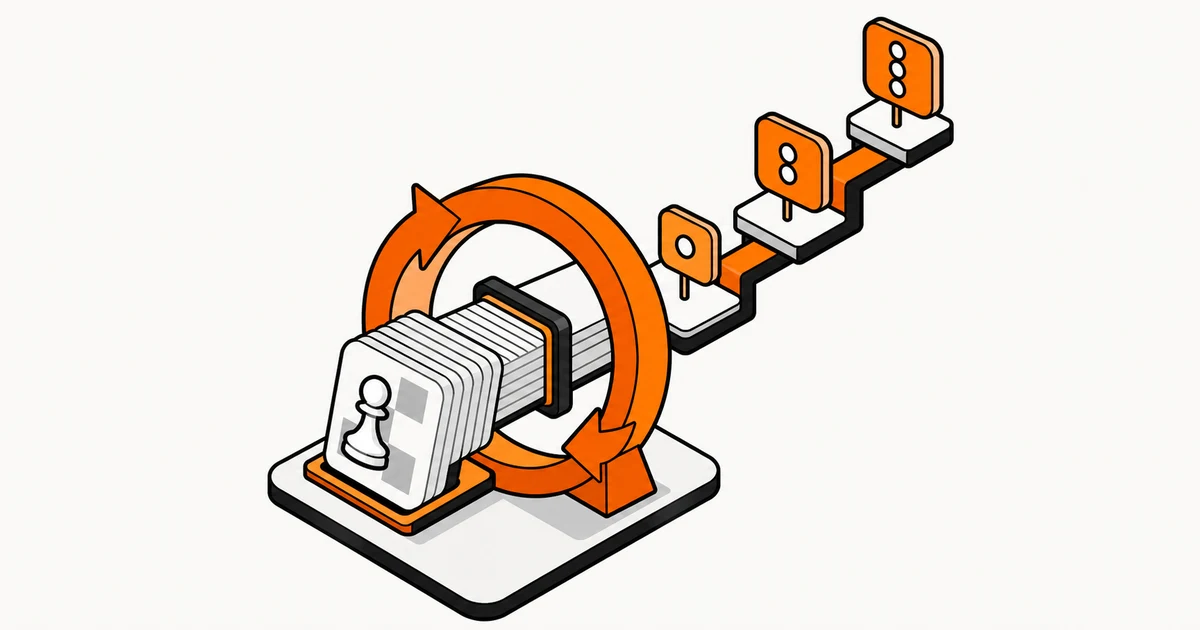
The best way to memorize chess openings is not to repeat long move lists. Build a smaller repertoire, understand the plan behind each branch, train the moves with active recall, review weak lines with spaced repetition, and test the opening in real games.
Opening memory usually fails for one of four reasons.
First, the repertoire is too large. A player adds every interesting sideline, but cannot maintain the core branches.
Second, the study is too passive. Watching explanations and reading PGN can build understanding, but it does not force recall.
Third, review is random. Players revisit lines when motivated, not when the line is about to fade.
Fourth, the repertoire is disconnected from real games. The player studies what looks important in theory, while the same practical sideline keeps causing problems over the board.
Step 1: reduce the repertoire
The fastest way to remember more is to study less at first. Start with one main response, two common sidelines, and the plans that explain them.
Depth should follow need. If a variation appears often and creates difficult decisions, it deserves attention. If it is rare and you do not understand the resulting position, it can wait.
A practical repertoire is not a museum. It is a tool for your next games.
Moves without meaning are easy to forget. A line becomes more memorable when you know the plan: which pawn break matters, which piece belongs on which square, what trade helps you, and what type of middlegame you want.
When adding a branch, write a short note in plain language. Do not only write the move. Write why the move exists.
This is where a structured PGN workflow matters. The comments and branches should support memory, not just document theory.
Step 3: train active recall
Active recall means the answer is hidden. You must produce the move yourself.
This is the difference between “I know this line when I see it” and “I can play this line in a game.”
A strong opening session should feel like a sequence of decisions. You choose the move, see immediate feedback, repeat weak branches, and return to the same position later.
Use the Opening Trainer for this part. The goal is to make the first moves automatic enough that you can spend energy on the middlegame plan.
Step 4: use spaced review
Forgetting is not a failure. It is normal. The problem is reviewing without a schedule.
Spaced review gives the repertoire a rhythm. Difficult lines come back sooner. Stable lines wait longer. Instead of asking “what should I review today?” the system surfaces the fragile material.
This matters for openings because move orders are unforgiving. One forgotten move can change the position completely.
Step 5: test against realistic replies
Do not memorize only the ideal main line. Real opponents choose side moves, shortcuts, traps, and move-order tricks. Your memory has to survive those branches.
Use common replies as training pressure. If a sideline appears frequently at your level, it deserves a simple answer and a plan.
This is also why your repertoire should stay personal. A line that matters for one player may be irrelevant for another.
Step 6: let your games decide what to fix
Your games are the best filter. If you forgot a line, add it to review. If you misunderstood a plan, add a note. If you lost from the same sideline twice, simplify or repair that branch.
ChessFlare connects this with game sync and Game Summary, so your repertoire can improve from the positions you actually reach.
A 15-minute routine
Use five minutes to review due lines. Use five minutes to train one branch without hints. Use five minutes to update one note from a recent game.
That is enough to compound. The routine works because it is small, repeatable, and connected to real play.
Final advice
Do not memorize chess openings by trying to hold a giant file in your head. Build a compact repertoire, understand the plans, recall moves actively, review them on schedule, and let your games guide the next update.
Memorizing chess openings FAQ
Simple answers for remembering openings longer.
How many opening lines should I memorize?
Start with the lines you actually play and the replies you actually face. A compact repertoire reviewed consistently beats a huge file you never maintain.
Is spaced repetition useful for openings?
Yes. It is useful because opening memory depends on move order, timing, and repeated recall.
Should I memorize moves or ideas?
Both. Ideas make the moves easier to remember, and move recall makes the ideas usable in a real game.
How can ChessFlare help?
ChessFlare connects PGN structure, active recall, spaced review, mobile practice, and feedback from real games.
Should I memorize chess openings move by move?
Only for critical branches. For most lines, memorize the plan first, then train the move order with active recall.
How many opening moves should beginners memorize?
A beginner should keep it small: one White setup, one answer to 1.e4, one answer to 1.d4, and the plans behind the first decisions.